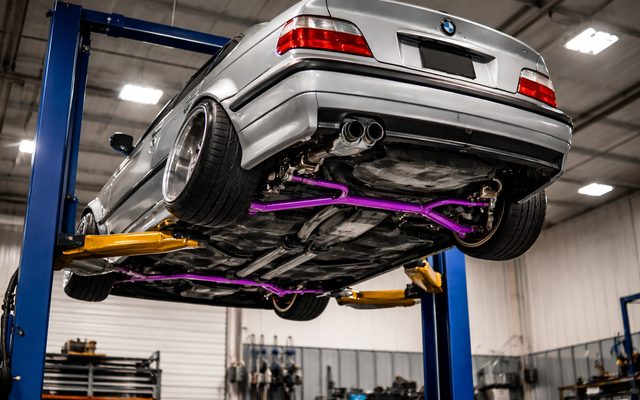
In the high-stakes arena of contemporary professional sliding, success is far more than solely a result of raw engine power or driver courage. Conversely, it has evolved into a multifaceted science which demands a meticulous blend of choosing a time-tested vehicle platform, outfitting it with the most precise performance hardware, and, most importantly, grasping its real-time characteristics on the circuit through sophisticated drift telemetry software. This exhaustive guide functions as your blueprint starting from the very first concept of a project car through to the last data-informed tweaks that turn a powerful machine into a repeatable winner. We will thoroughly explore the methodical process of vehicle alignment optimization, illustrating how a advanced suspension tuning tool like a dedicated telemetry system eliminates assumptions and offers unmatched clarity into your car's actual dynamics.
The foundation of any exceptional competitive sliding vehicle is, undoubtedly, the base vehicle itself. Several vehicles have achieved renowned standing within the global drifting scene due to their natural handling characteristics, durable design, and the immense ecosystem of specialist components available. Selecting the correct car is the first and most significant choice a enthusiast will make. To illustrate, the the E36 generation BMW is universally acknowledged as one of the greatest balanced drift platforms of history. Its almost ideal balanced front-to-rear weight, coupled with a rear-wheel-drive setup and robust six-cylinder motors, establishes a platform that is both easy to handle for newcomers and extremely effective in the control of a expert pilot. The next step of this philosophy, the E46 model BMW, improves on these attributes with a more developed structure, increased wheel track for greater stability, and still more turning capability straight from the OEM. A different dominant platform in the professional scene is the Corvette C6.
This V8-powered track weapon introduces a particular set of strengths to the drifting discipline, including a light aluminum frame, a rear-mounted drivetrain component that aids in an perfect balance, and the colossal torque of a big GM LS engine. This combination renders it an complete weapon on track, able of entering and holding continuous drifts with apparently minimal application of power. For builders desiring exceptional bang-for-the-buck, the Nissan Z33 excels as a prime example. It comes from the manufacturer with a robust chassis, a competent OEM LSD, and the responsive VQ series motor that delivers plenty of power and torque for learning and progressing in the activity. Its newer version, the 370Z model, brings more advancements in chassis stiffness, steering geometry, and outright engine output, solidifying its position as a popular choice among competitive competitors. Further historic vehicles that warrant attention encompass the nimble Wankel-engined FC generation RX-7, the ever-present S13 Silvia/240SX, the torque-rich Ford Mustang SN95, the modern BMW E90, and the small yet unbelievably playful and instructive MX-5 Miata. Every single one of these platforms provides a unique set of attributes, complexities, and capabilities, but they all have in common the fundamental components necessary to serve as a capable drift machine.
However, selecting the optimal car is only the beginning. To access the full potential of every of these machines, substantial modifications to the steering geometry and damping and springing systems are completely mandatory. This is where the domain of performance tuning hardware enters sharp importance. The one most transformative improvement for a dedicated competition vehicle is the fitting of a high-performance angle modification kit. These advanced assemblies, like those developed by specialist companies like SLR, are created to radically increase the car's maximum turning lock. A standard production vehicle is highly restricted in how far its tires can turn, a safety compromise for public road operation. In sliding, conversely, extreme opposite lock is frequently required to control and sustain a slide. An modification kit replaces the stock steering knuckles, tie rods, and often A-arms with components that enable the front tires to attain angles beyond 70 or even 80 °, compared to a average OEM angle of around 40 to 50 degrees.
This immensely expanded capability offers the driver with dramatically greater authority during a drift, allowing it to be much simpler to begin a oversteer moment, sustain it through a long turn, and switch seamlessly from one angle to the opposite. The improvement in handling is nothing short of revolutionary. Paired with a correctly chosen steering kit is the just as essential modification to the car's damping system. Off-the-shelf or even high-end street coilovers are simply not intended for the particular and extreme needs of competitive oversteer. A drift-spec pair of adjustable dampers is crucial. These specific dampers feature custom valving and spring strength that are designed for the extreme load shifting that is inherent of drifting. When a pilot starts a drift, the vehicle's weight is shifted violently to the front of the corner. Proper drift-spec suspension manage this transfer in a predictable way, permitting the vehicle to find its balance rapidly and providing the driver clear feedback through the controls and driver's seat. They additionally allow for accurate tuning of stance, shock absorber rate, and weight balance, which are all fundamental elements of dialing in the vehicle's dynamics to a given circuit or driving approach. In combination, a high-quality angle modification system and a correctly selected set of drift-spec adjustable dampers form the core mechanical cornerstone upon which all subsequent refinement is built.
Once the essential hardware is fitted, the subsequent vital stage in the development is the precise setting of the car's suspension geometry. This is the realm of car suspension tuning, a methodology that can seem intimidating to the uninitiated but is, in practice, the secret to transforming a assembly of capable parts into a unified and controllable whole. The most critical parameter of suspension geometry for oversteer is undoubtedly camber angle. Wheel camber is the angle of the wheel in relation to the perfectly straight axis when looked at from the forward of the car. If the upper part of the tire is tilted towards the car, this is known as negative camber. For sliding, negative camber on the front axle tires is widely applied and is seen as essential. The reason is intrinsically tied to vehicle dynamics.
When a car is going around a bend at limit sideways angles, the frame tilts toward the outside of the corner. This chassis roll makes the outer front wheel to diminish its best grip area with the asphalt. By applying inward lean, the wheel is pre-angled to counteract this lean. As the vehicle rolls into the turn, the tire becomes more upright on the road surface, maximizing its grip at the critical point when it is absolutely essential for directional command. Commonly, front axle adjustments for a serious drift machine range from approximately -3 degrees to as much as -5 degrees or even beyond, contingent on the details of the car setup, compound type, and pilot preference. The back tires also use negative camber, but the values are typically more modest and subtler than the front axle. Too much negative camber at the back can result in the chassis extremely tail-happy and difficult to predict on throttle application, as it shrinks the available contact patch of the driven wheels during linear power delivery. Therefore, rear axle camber settings are commonly in the ballpark of -1 degree to -3 degrees, striking a careful balance between giving enough lateral grip to aid in starting and sustaining the slide while simultaneously keeping good hook-up for acceleration the bend. Camber is merely drift suspension tuning guide one element of the more complex alignment equation, which also encompasses toe setting, caster, and suspension-induced steering correction.
Toe angle refers to the direction of the tires when viewed from the top. Positive toe means the front edges of the wheels are nearer together than the rear edges, while outward toe means the converse. For oversteer, a modest amount of front toe out is commonly run to sharpen the turn-in directional response, making the vehicle feel more responsive and ready to initiate a drift. Rear axle toe angle is typically set to zero or a extremely minute amount of positive toe to promote predictability under throttle. self-centering is the forward or backwards angle of the suspension pivot when observed from the side of the chassis. Positive caster improves feedback and stability solidity, and it furthermore increases negative camber gain during cornering, which is highly useful. Tuning these settings is a complex dance where a adjustment to one value can and will affect the remaining parameters. The old-school method for setting a vehicle's suspension geometry for sliding has historically been a time-consuming endeavor of experimentation and feeling. A pilot or team would apply a change based on a hunch, drive the chassis on track, use the operator's personal perception and comments, and then make a further adjustment. This loop would repeat again and again until the car felt "right" or the scheduled testing period was exhausted. This system is not only extremely inefficient in terms of hours and tires, fuel, and parts, but it is also inherently flawed.
Driver sensation is a notoriously inconsistent measurement tool, colored by many factors such as tiredness, evolving track conditions, ambient heat, and merely the mood of the driver on that specific run. What feels "loose" on one run might feel "pushing" on the next lap, resulting in contradictory feedback and ineffective changes. This traditional challenge in chassis setup is precisely where contemporary engineering tools has made its mark to revolutionize the process.
The rise and adoption of specialized suspension tuning applications has ushered in a completely new age for engineering and refining professional sliding vehicles. This new generation of systems, exemplified by innovative products like modern telemetry hardware, operate by physically capturing the live mechanical movement of the car as it is operated on the circuit. In contrast to depending on driver feedback, these devices acquire quantifiable information on critical variables such as shock absorber movement, individual tire rotation, G-force loading, wheel angle, and accelerator and brake pedal application. This raw data stream is then interpreted by sophisticated algorithms that can graph and interpret the information in a actionable way. For the very first time, tuners and teams can visualize precisely what the vehicle is doing at each moment of a slide. This capability transforms the complete chassis setup procedure. Consider the aforementioned task of dialing in the suspension tuning tool front axle camber for a particular vehicle. Rather than making a modification from -3 degrees to -3.5 degrees and then testing multiple passes to try and "sense" a improvement, a telemetry system can provide real-time and clear feedback. The tool can show in a chart how the wheel's loading is performing during the key stages of a drift: turn-in, mid-corner, and transition. It can reveal if the present camber setting is allowing the steering tire to keep maximum contact or if the rubber is overloaded on its outside car suspension tuning shoulder.
The system can after analysis make empirical recommendations for change. Perhaps the information indicates that the outside front tire is still stressing its sidewall at -3.5 degrees of camber, indicating that a move towards negative camber, say -4 degrees, might be beneficial. On the other hand, the information might show that the tire is failing to achieving optimal operating temp or that the inside edge is wearing too quickly, which could indicate that there is overly aggressive negative camber and a small reduction back to -3.2 degrees would be more ideal. This standard of granularity and useful intelligence was completely unimaginable in the days of solely seat-of-the-pants tuning.
The impact of using a comprehensive suspension tuning tool reaches much further than merely optimizing camber angles. It serves as an invaluable suspension tuning guide that is specific to your particular car. When adjusting the rebound and compression values on your adjustable dampers, rather than relying on vague advice or copying another driver's setup, you can utilize the data to observe how the car is reacting in reaction to your adjustments. The software can display the suspension travel trace over a lap, revealing if the coilovers are controlling the weight transfer effectively or if they are permitting the chassis to oscillate excessively after a direction change. It can assist in identifying problems like hitting the bump stops or losing droop, enabling you to make informed decisions to helper springs, rebound/compression values, or stance. This methodology translates equally to the complex art of corner balancing. Beyond camber, the software can offer data into how changes to toe and caster angle are influencing the car's stability during specific parts of a drift. For instance, it can assist you to determine the best amount of front toe-out for your individual steering rack configuration and driving style by showing the quickness of turn-in response and the predictability of the vehicle at lock countersteer. This makes the system an exceptionally useful performance optimization handbook that is actively updated by the live behavior of your own chassis on the track. It shifts the entire process from a mysterious craft into a scientific development process.
Moreover, the application of a tool like modern telemetry is in no way confined to expert engineers with vast funding. For the grassroots enthusiast, it functions as an incredible equalizer. It effectively gives the tuner with the insight of a full-time suspension specialist without the corresponding overhead. It accelerates the development time by delivering clear solutions to problems that would normally take seasons of trial and error to solve. A tuner can learn how their particular vehicle behaves to different inputs, developing a more intuitive knowledge of vehicle dynamics in the process. It additionally makes accessible professional suspension engineering concepts, allowing every enthusiast with the desire to optimize their vehicle to achieve it in a efficient and successful fashion. This is notably significant in a sport like drifting, where setup knowledge has historically been a closely guarded commodity among top teams. Now, that knowledge can be in the hands of any motivated builder.
In the final analysis, the process to building and tuning the ultimate competitive drift car is a multi-stage endeavor that seamlessly integrates proven engineering knowledge with revolutionary data technology. It begins with the informed pick of a capable chassis, followed by the application of non-negotiable drift-spec components like maximum-angle angle modification systems and expertly specified drift-spec coilovers. The build then progresses into the detailed stage of alignment optimization, where settings like camber, toe setting, and caster are precisely set to match the chassis's modified capabilities and the driver's personal style. Finally, and what genuinely separates the today's methodology from the past, is the adoption of a sophisticated suspension tuning application. This system eradicates the uncertainty and inefficiency of solely subjective setup by providing quantifiable, actual telemetry on how the chassis is truly functioning. It acts as an indispensable suspension tuning tool, a actionable coilover setup manual, and a all-in-one performance analyzer. As a complete package, this holistic approach leads to that every element of the competition vehicle—from the selection of the platform to the most minute click on the coilover—is perfected for maximum competitiveness on the track. It signifies the complete progression of the sport of sliding, merging mechanical driving skill with surgical chassis dynamics to forge the most effective cars imaginable.